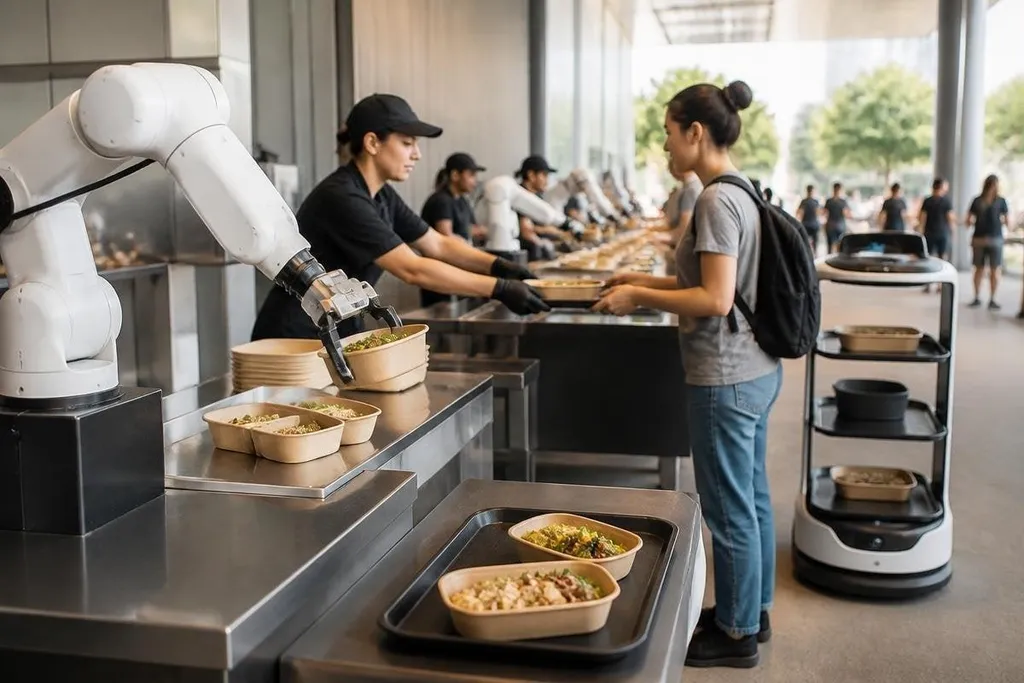
Meal-service robots can place food into trays, move meals across a venue, or hand over sealed dishes. Serving thousands of people depends on the full setup: menu, kitchen, staff, cleaning, queue design, and backup plans.
- Robots work best with repeatable meals and fixed serving points.
- A busy event needs several stations, not one machine doing every task.
- Throughput, cleaning time, and human support matter more than a robot’s top speed.
Where robots can help
Meal service has many repeated movements. One robot arm can pick a container, place it in a tray, and pass it to a worker or guest. A mobile robot can carry meals between a kitchen and a serving area when the route stays clear.
The useful part is the repeat work. Robots can repeat the same motion without tiring, while people handle menu changes, guest questions, spills, and tasks that need judgment. That split can work well at a conference, sports venue, or large public event with a fixed menu.
A robot’s tool matters too. The end effector is the part that touches the food or container. A gripper made for sealed boxes may handle meal trays well, while a tool for loose food needs a different design, cleaning method, and safety check.
Why one robot won’t serve the crowd
Thousands of meals create a flow problem. Food must leave the kitchen, reach the right station, wait in a queue, and reach the guest at a safe temperature. A delay at one point can hold up everything behind it.
Several robots can split the work. One group can move empty trays, another can carry finished meals, and fixed stations can handle the final handoff.
This layout reduces the distance each robot travels, but it adds control work, charging needs, floor space, and staff training.
Menu design sets the limit. Meals with the same container, portion shape, and handoff point are easier to automate than orders built from many choices. A menu with several allergens also needs clear labels and a process that keeps the wrong meal away from the wrong guest.
At a busy event, one missed allergen label can turn a fast serving line into a safety problem. Food robotics reporting from Robot24.com can put the robot’s menu, serving steps, and human checks beside the test result. Food safety gets the first check, before speed.
Food safety comes before speed
Food service gives robots less room for error than warehouse work. Surfaces need a cleaning plan, tools must avoid cross-contact, and staff need a clear way to stop the system when a container falls or a guest reaches into the work area.
The venue also needs a manual process. A robot may lose its route, drop a tray, or stop when a sensor sees an unexpected object. Human staff must know how to clear the area, protect the food, and keep meals moving while the fault is fixed.
Exact capacity needs proof from the supplier. Ask for measured output with the planned container, menu, staff count, cleaning pauses, and queue layout. A cycle time from a short demonstration does not tell you how many meals the full event can serve.
A practical event check
Use these points before signing a robotics contract:
- Menu fit: fixed portions, containers, and handoff steps
- Measured flow: meals per hour under event conditions
- Food contact: approved materials and cleaning instructions
- Human cover: staff assigned to loading, checks, and faults
- Fallback service: manual stations ready for stoppages
- Site limits: floor space, power, Wi-Fi, lifts, and access routes
The strongest plan starts with one repeatable job, such as moving sealed meals from the kitchen to a serving point. The team can measure queue time, missed handoffs, cleaning time, and staff workload before adding more robots.
I’d use robots for repeatable transport or handoff first, then consider food handling after the supplier proves safe cleaning and steady output at the venue.
The open number is meals per hour after stops, cleaning, and human checks. Until a supplier gives that figure for your menu and site, plan the event around people and treat the robots as added capacity.